

Most owner-operators can tell you their fuel cost per mile without blinking. Fewer can tell you their true cost per mile the number that includes insurance, truck payments, permits, software subscriptions, and every other cost that keeps running whether you’re loaded or sitting empty.
That gap is where profitable-looking months turn out to be break-even months, and where a load that seemed worth taking quietly loses money. Here’s how to actually calculate your true cost per mile including the overhead most drivers never account for and what to do with the number once you have it.
How to Calculate Cost Per Mile (Step by Step)
Cost per mile = total operating costs for the period ÷ total miles driven in the same period (loaded and empty).
Here is the full calculation for one month, for an owner-operator who drove 9,000 total miles.
Step 1: Total your fuel cost. 9,000 miles ÷ 6.5 MPG = 1,385 gallons. 1,385 gallons × $3.80 per gallon = $5,262.
Step 2: Add maintenance and tires. Maintenance reserve: 9,000 × $0.12 = $1,080. Tires: 9,000 × $0.03 = $270.
Step 3: Add your fixed overhead. Insurance, truck payment interest, permits, ELD, bookkeeping, phone and parking = $1,315.
Step 4: Add it all together. $5,262 + $1,080 + $270 + $1,315 = $7,927 total monthly cost.
Step 5: Divide by total miles. $7,927 ÷ 9,000 miles = $0.88 per mile.
| Cost category | Monthly cost | Per mile |
|---|---|---|
| Fuel | $5,262 | $0.58 |
| Maintenance reserve | $1,080 | $0.12 |
| Tires | $270 | $0.03 |
| Fixed overhead | $1,315 | $0.15 |
| Total | $7,927 | $0.88 |
That $0.88 is your break-even. Any load paying less than that, averaged across all your miles, loses money before you have paid yourself a dollar.
Why Deadhead Miles Must Be Included in Your Cost Per Mile
Deadhead miles are the miles you drive empty, to pick up a load or to get home. You earn nothing on them, but they still burn fuel, wear your tires and use up the time your fixed costs are paying for. That gives you two numbers to know:
- Cost per total mile: all costs ÷ all miles (loaded + empty). This is the real cost of running the truck.
- Cost per loaded mile: all costs ÷ paid miles only. This is what each paid mile has to cover.
Using the example above, say 1,350 of the 9,000 miles (15%) were deadhead:
- Cost per total mile: $7,927 ÷ 9,000 = $0.88
- Cost per loaded mile: $7,927 ÷ 7,650 loaded miles = $1.04
That 16-cent gap is why a load that looks profitable at $1.00 per mile can lose money once you count the empty miles it took to get there. When you check a rate, compare it with your cost per loaded mile, or add the deadhead to get there into the trip miles before you divide.
Common mistake: some drivers divide by loaded miles only and call that their cost per mile. Others divide by all miles but then compare it with load rates as if every mile were paid. Either way, the empty miles get lost and the numbers look better than they are.
Why “Cost Per Mile” Usually Means Half the Real Cost
Ask most owner-operators their cost per mile, and you’ll get fuel plus maybe maintenance, the costs that feel tied directly to driving. What almost never makes it into that number is overhead: the costs that exist whether the truck moves 3,000 miles this month or sits for a week.
- Truck insurance
- Truck payment (the interest portion, specifically more on this below)
- Permits, registration, IRP fees
- ELD and software subscriptions
- Bookkeeping and accounting fees
- Phone and communication costs
- Occupational accident or health insurance
None of these show up on a fuel receipt. All of them are real costs that every mile you drive has to help pay for. Leave them out of your cost-per-mile number, and every load looks more profitable than it actually is.
The Concept Behind This: Predetermined Overhead Rate
In general business accounting, this idea has a name: the predetermined overhead rate a way of spreading fixed, indirect costs across the actual units of output (in a factory, that’s usually machine hours or labor hours; for an owner-operator, it’s miles driven).
The formula, translated for trucking:
Estimated monthly overhead costs ÷ estimated monthly miles = overhead cost per mile
That number gets added to your direct, per-mile costs (fuel, maintenance) to get your true cost per mile the number that should actually drive whether a load is worth taking.
Calculating Your Real Overhead Cost Per Mile
Step 1: Add up your monthly overhead costs.
Take everything that costs money whether you drive or not:
| Overhead Item | Example Monthly Cost |
| Truck insurance | $500 |
| Truck payment (interest portion) | $400 |
| Permits & registration (averaged monthly) | $10 |
| ELD subscription | $40 |
| Bookkeeping | $200 |
| Phone/communication | $75 |
| Parking & truck stop fees (averaged) | $90 |
| Total monthly overhead | $1,315 |
Step 2: Estimate your monthly miles.
Use a realistic average, not your best month. If you typically run 8,000–10,000 miles a month, use the lower end for a conservative number it’s better to overestimate your true cost per mile than underestimate it.
Example: 9,000 miles/month.
Step 3: Divide.
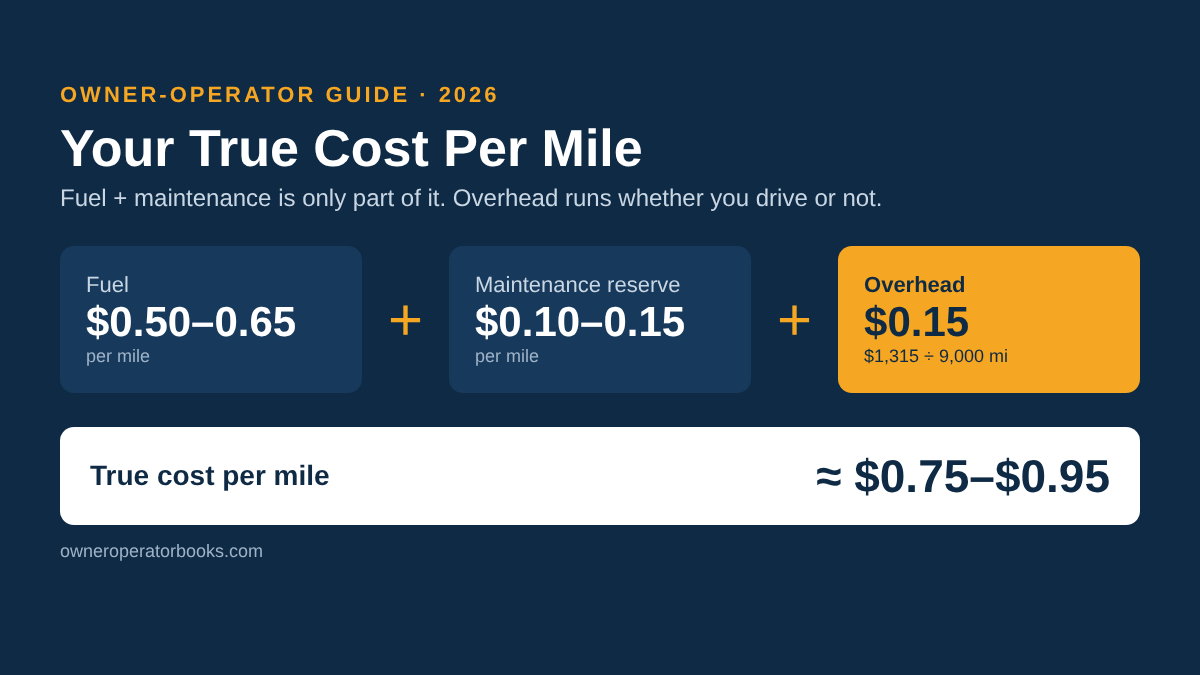
$1,315 ÷ 9,000 miles = $0.15 per mile in overhead alone.
That’s before a single gallon of fuel or dollar of maintenance is counted. Add your actual fuel cost per mile (commonly $0.50–$0.65 depending on current diesel prices and your truck’s MPG) and a reasonable maintenance reserve per mile (often $0.10–$0.15), and a driver who thought their cost per mile was around $0.60 might discover it’s closer to $0.75–$0.95 once overhead is properly included.
That’s not a small rounding error. On a load paying $1.20/mile, that’s the difference between a genuinely solid margin and one that barely clears expenses.
Fixing What the Concept Gets Wrong If You Stop Here
Overhead-per-mile is a genuinely useful number, but it has real limitations if you calculate it once and never touch it again this is where a lot of explanations of this concept stop short, without saying what to actually do about it:
It’s based on estimates, so it drifts. Fuel prices change, insurance renews at a different rate, a slow month drops your mileage. The fix: recalculate monthly, not annually. A number that’s a year stale is closer to a guess than a fact.
A single average hides real variation. A month where you’re mostly running short, well-paying regional loads looks very different from a month of long, cheap deadhead-heavy runs even at the same total mileage. The fix: if you run meaningfully different types of freight, calculate overhead-per-mile separately for each pattern rather than using one blended number for every decision.
It can lead to bad decisions if treated as gospel. A load that pays exactly your calculated cost per mile isn’t actually profitable it’s break-even before accounting for your own time and any unexpected costs. The fix: treat your true cost per mile as the floor, not the target. Price and load decisions should aim comfortably above it, not right at it.
What This Number Is Actually For
Once you know your real, overhead-inclusive cost per mile, it changes real decisions:
- Evaluating a load offer — is $1.10/mile actually worth it once overhead is included, or is it quietly a loss?
- Deciding on a new truck payment or insurance change — how many additional cents per mile does this new fixed cost add, and can your typical freight actually absorb it?
- Comparing lanes or freight types — some routes only look more profitable because their overhead hasn’t been properly allocated
- Knowing when you’re actually growing — revenue going up means nothing if your true cost per mile is quietly rising just as fast
Why Only the Interest Portion of the Truck Payment?
The overhead list above counts only the interest part of your truck payment, and that is deliberate. The principal portion pays down your loan; it is not an expense on your profit and loss statement. The cost of the truck itself reaches your books through depreciation instead, which your tax preparer handles.
That said, the full payment still leaves your bank account every month. A practical approach is to track two numbers: an accounting cost per mile (interest plus depreciation) for measuring profit, and a cash cost per mile (the full payment) for making sure you can cover the bills. If the cash number is higher than your typical freight leaves room for, you will feel it in your checking account even when the P&L looks fine.
A Complete Cost Per Mile Example
Here is how the pieces fit together for a hypothetical owner-operator running 9,000 miles a month. Your numbers will be different; the method is what matters.
| Cost component | How it is calculated | Per mile |
|---|---|---|
| Fuel | $3.80/gal diesel ÷ 6.5 MPG | $0.58 |
| Maintenance reserve | Set aside every mile for repairs | $0.12 |
| Tires | Replacement cost spread over expected tread life | $0.03 |
| Overhead | $1,315 ÷ 9,000 miles | $0.15 |
| True cost per mile | $0.88 |
At $0.88, a load paying $1.20 a mile leaves $0.32 per mile before you have paid yourself. Over 9,000 miles, that is about $2,880 for the month, and it still has to cover your own pay, taxes and anything that breaks unexpectedly. A load at $1.00 leaves only $0.12 per mile. Fuel-only math would have told you both loads were comfortably profitable.
Turning Cost Per Mile Into a Minimum Rate
Your true cost per mile is your break-even. To get a minimum rate you will actually accept, add two more things.
1. Pay yourself per mile
Decide what you need to take home each month, then divide by your miles. If you want $6,000 a month on 9,000 miles, that is about $0.67 per mile. Add it to your cost: $0.88 + $0.67 = $1.55 per mile.
2. Adjust for deadhead
If roughly 15% of your miles are empty, only 85% of your miles are paid. Divide by 0.85 to get the rate you need per loaded mile: $1.55 ÷ 0.85 ≈ $1.82.
That $1.82 is your floor for loaded miles, not your target. It tells you which offers to turn down quickly and gives you a firm number to negotiate from.
How to Account for Your Own Pay as an Owner-Operator
Your own pay is the cost most owner-operators leave out, and how it shows up in your books depends on how your business is set up.
Sole proprietor or single-member LLC: what you take out for yourself is an owner’s draw, not a business expense, so it does not appear on your profit and loss statement. That means the net profit on your P&L is not extra money. It is your pay, and income tax and self-employment tax still come out of it. If your P&L shows $5,000 profit for the month, that $5,000 is all you earned for working the month.
LLC taxed as an S-corp: you pay yourself a reasonable salary through payroll. That salary and the employer payroll taxes on it are business expenses and do appear on your P&L. Money you take out beyond the salary is a distribution, not an expense.
How to handle it in your cost per mile:
- Keep two numbers: your operating cost per mile (the truck and the business) and your owner pay per mile (what you need to take home ÷ monthly miles).
- As a sole prop or LLC, add owner pay on top of operating cost to get your minimum rate. As an S-corp, your salary is already in operating costs, so do not count it twice.
- Set aside for taxes from every settlement. Self-employment tax alone is 15.3% on most net earnings, before income tax. Moving a fixed percentage into a separate account keeps tax season from wiping out a month of profit.
Your tax preparer can tell you which setup makes sense for your level of profit. Either way, your cost per mile only tells the truth once your own pay is part of it.
Cost Per Mile vs. Revenue Per Mile
Revenue per mile is what you earn: total revenue divided by total miles. Cost per mile is what each mile takes to run. The gap between them is your margin per mile, and it is the number that tells you whether the business is healthy.
Watching only revenue per mile is a common trap. A month with high rates can still be a weak month if fuel spiked, a repair hit, or miles dropped and spread your overhead over fewer miles. Track both numbers side by side every month and watch the gap, not just the top line. For example, if your revenue across all miles works out to $1.70 and your true cost per mile is $0.88, you keep $0.82 per mile to cover your pay, taxes and savings.
Cost Per Mile vs. Cost Per Hour
Cost per mile tells you what each mile costs. Cost per hour tells you what each hour of your working time costs, including the hours when the wheels are not turning.
Cost per hour = total monthly costs ÷ total on-duty hours
In the same example, 9,000 miles at an average of about 50 mph is roughly 180 hours of driving, plus around 40 hours of loading, unloading, fueling and inspections. That is 220 on-duty hours: $7,927 ÷ 220 hours = about $36 per hour.
When to use which:
- Long-haul OTR: cost per mile is the main number, because most of your time is spent driving at highway speed.
- Local, regional and short-haul: cost per hour often matters more. Traffic, multiple stops and dock time mean you can work a full day and log very few miles.
- Detention and waiting time: cost per hour shows what sitting really costs you. Three hours at a dock is not free, because your insurance, truck payment and your own time keep running. Use your hourly number when you negotiate detention pay or decide whether a load with a long wait is worth taking.
Keep track of both. A load can look fine per mile and still be a bad deal per hour if it eats your whole day.
How Mileage Changes Your Overhead Per Mile
Because overhead is fixed, the number of miles you run has a big effect on how much of it each mile carries. Using the same $1,315 in monthly overhead:
| Monthly miles | Overhead per mile | Change vs. 9,000 miles |
|---|---|---|
| 6,000 | $0.22 | +$0.07 |
| 9,000 | $0.15 | — |
| 12,000 | $0.11 | −$0.04 |
A slow month from a breakdown, a holiday or a few days waiting on freight raises every remaining mile’s share of the fixed bills. That is why a rate that worked fine in a busy month can quietly lose money in a slow one, and why it pays to know your number at a few different mileage levels, not just one.
Practical Ways to Lower Your True Cost Per Mile
Once the number is visible, you can work on it. A few levers owner-operators commonly use:
- Shop insurance at renewal. Insurance is usually the largest fixed cost, so even a modest saving moves your overhead per mile.
- Cut unpaid miles. Better load planning and fewer empty miles spread fixed costs over more paid miles.
- Watch fuel economy. Speed, idle time and tire pressure all show up in MPG, and fuel is the biggest per-mile cost.
- Stay on top of preventive maintenance. Scheduled service is cheaper than roadside repairs and lost days.
- Review subscriptions and fees. Small monthly charges for apps, load boards and services add up across a year.
None of these needs to be dramatic. Taking a few cents off your cost per mile is worth hundreds of dollars a month at typical mileage. For example, saving $0.03 per mile across 9,000 miles is $270 a month, or more than $3,000 a year.
Common Cost Per Mile Mistakes to Avoid
- Using your best month’s miles. A strong month spreads overhead thin and makes your cost per mile look better than it usually is.
- Ignoring annual and quarterly bills. Permits, IRP renewals, the heavy vehicle use tax (Form 2290) and insurance down payments need to be averaged into monthly figures, or the months they land in will distort your numbers.
- Leaving out your own pay. If your numbers include no owner’s pay, the “profit” is really just your wages.
- Mixing personal and business spending. Personal charges on the business card blur the true cost and make the numbers hard to trust.
- Skipping a maintenance reserve. Cheap months look great until a major repair arrives all at once.
- Calculating once and forgetting it. Costs change, and the number needs to change with them.
How to Track Your Cost Per Mile Each Month
You do not need complicated software, just a consistent routine:
- Record total miles from your ELD or odometer at month-end, loaded and empty.
- Reconcile your fuel card statements and fuel receipts. The same records support your IFTA filing.
- Categorize every expense (fixed overhead, fuel, maintenance and repairs, tires) in your bookkeeping system.
- Divide each category by total miles and compare with the last few months.
- Look into any jump of more than a few cents per mile right away, before it costs you a month of thin margins.
After three or four months, you will have a trend line instead of a guess, and you will know quickly when an insurance renewal or a rise in diesel prices moves your true cost per mile.
How Often Should You Recalculate Your Cost Per Mile?
Monthly, as a routine. Update the number with each month-end close, using that month’s actual miles and expenses.
Right away when something big changes. Do not wait for month-end if any of these happen:
- Your insurance renews or your premium changes
- You take on a new truck payment, refinance or pay off the truck
- Diesel moves about 25 cents a gallon. At 6.5 MPG, that is close to 4 cents per mile.
- Your monthly miles change by about 10% or more (a slow season, time off or a new lane)
- You change the kind of freight you haul, for example going from OTR to regional or adding a dedicated lane
- A major repair shows your maintenance reserve is too low
Quarterly: compare your numbers with your IFTA mileage and fuel records. They should match.
Yearly: rebuild the whole calculation at tax time, including depreciation, annual permits, Form 2290 and your real maintenance history for the year.
A cost per mile that is three months old is usually still close. One that is a year old is a guess.
Cost Per Mile for a Personal Car or Pickup
The same formula works for any vehicle: total costs ÷ total miles. For a personal car or commuter vehicle driven 1,200 miles a month, it might look like this:
| Cost | Monthly | How it is figured |
|---|---|---|
| Fuel | $137 | 1,200 miles ÷ 28 MPG × $3.20/gal |
| Maintenance & tires | $120 | About $0.10 per mile |
| Insurance | $150 | Monthly premium |
| Registration (averaged) | $15 | Annual fee ÷ 12 |
| Depreciation | $250 | Estimated loss in value per month |
| Loan interest | $60 | Interest portion only |
| Total | $732 |
$732 ÷ 1,200 miles = about $0.61 per mile. As with a truck, fixed costs such as insurance, depreciation and registration make up most of that number. For comparison, the IRS business standard mileage rate is 76 cents per mile for miles driven from July 1 through December 31, 2026 (it was 72.5 cents for January 1 through June 30, 2026, before the IRS raised it mid-year). The standard rate is meant to cover the full cost of running a typical car, including depreciation.
Why this matters to owner-operators: if you use a personal pickup or car for business trips to the shop, the bank or a parts store, log those miles. Business use of a personal vehicle can be deductible, using either the standard mileage rate or actual expenses. For 2026, log the date of every trip: miles driven before July 1 use 72.5 cents, and miles from July 1 onward use 76 cents.
Cost Per Mile FAQs for Owner-Operators
What is a good cost per mile for an owner-operator?
There is no single “good” number. It depends on your truck payment, insurance, lanes and fuel economy. Using the example figures in this guide, the true number lands around $0.75–$0.95 per mile once overhead is included, well above a fuel-only estimate. The figure that matters is the one calculated from your own books.
Should deadhead miles count when I calculate cost per mile?
Yes. Divide by total miles driven, loaded and empty. Your costs keep running on deadhead, so leaving those miles out gives you a number that does not match reality. Then make sure the rate on each load covers the empty miles it takes to get there.
What is the difference between fixed and variable costs?
Fixed costs, like insurance, the truck payment, permits and your ELD, stay the same whether you run 6,000 or 12,000 miles, so their per-mile share drops as miles go up. Variable costs, like fuel, tires and maintenance, rise with every mile. Tracking them separately shows exactly how much a slow month hurts.
How often should I recalculate my numbers?
Monthly, plus right away after a big change such as an insurance renewal, a new truck payment or a jump in diesel prices. See the recalculation checklist above for the full list.
Do I need software to track my cost per mile?
No. A spreadsheet works if you update it every month with accurate, categorized numbers. The hard part is the clean bookkeeping behind it, which is why many owner-operators hand that part off.
Should taxes be part of my cost per mile?
Income taxes depend on your profit, so they are usually planned separately, by setting aside a share of each settlement, rather than built into the per-mile figure. Fuel taxes are already in the pump price, and items like the heavy vehicle use tax and permit fees belong in overhead.
How do you calculate cost per mile for a truck?
Add up all your costs for the month (fuel, maintenance, tires and fixed overhead) and divide by total miles driven, loaded and empty. For example, $7,927 in monthly costs ÷ 9,000 miles = $0.88 per mile.
What is the difference between cost per mile and cost per hour?
Cost per mile divides your costs by miles driven. Cost per hour divides them by on-duty hours, including loading, waiting and detention. Cost per mile matters most for long-haul work, and cost per hour matters more for local and short-haul work.
Is an owner-operator’s pay a business expense?
For a sole proprietor or single-member LLC, no. Owner’s draws are not expenses, so your P&L profit is really your pay. For an S-corp, a reasonable salary paid through payroll is a business expense.
Key Takeaways
- Fuel and maintenance are only part of the picture. Overhead such as insurance, truck payment interest, permits and software runs whether the truck moves or not.
- To find overhead per mile, divide total monthly overhead by realistic monthly miles, including deadhead.
- Add overhead to your fuel, maintenance and tire costs to get your true cost per mile, which is your break-even.
- Add your own pay and adjust for empty miles to set a minimum rate per loaded mile.
- Recalculate every month, and look at the trend rather than a single month on its own.
Why This Rarely Gets Calculated Correctly Without Help
The math itself isn’t hard. What’s hard is having accurate, current numbers for every overhead category, updated monthly, without it becoming its own part-time job. This is exactly the kind of number that’s easy to calculate once in a spreadsheet and then never update which makes it stale and misleading within a few months.
This is why cost-per-mile reporting is built into how we handle monthly bookkeeping, not treated as a separate one-time calculation.
Owner Operator Books is a Saint Paul, Minnesota bookkeeping firm working exclusively with truck drivers, owner-operators, and small fleets every monthly report includes your real cost-per-mile number, recalculated from your actual current numbers, not a stale estimate from months ago.
Book a free 20-minute consultation bring your last few settlement statements, and we’ll show you what your real number actually looks like.