

If you’re looking for a straight answer on IFTA filing Minnesota owner-operators can actually use, you’re in the right place. Every quarter, the same scene plays out in truck cabs across the state: a driver pulls up a pile of fuel receipts, tries to remember which states they ran through in February, and hopes the numbers they send in don’t trigger an audit.
It doesn’t have to be that way. IFTA is simple if your records are kept right all quarter, and miserable if they’re not. After 15 years of preparing IFTA returns for trucking clients, here’s the complete guide for Minnesota-based drivers: what IFTA is, the 2026 IFTA deadlines, how Minnesota’s program works, and the mistakes that cost drivers real money.
Table of Contents
What IFTA Actually Is
The International Fuel Tax Agreement (IFTA) is an agreement between the lower 48 states and the Canadian provinces that answers one question: which states get your fuel tax money?
Fuel tax is baked into every gallon you buy at the pump. But you don’t burn fuel where you buy it. You might fill up cheap in one state and burn most of that tank crossing two others. IFTA squares this up. Each quarter, you report:
- Miles driven in each state, and
- Gallons purchased in each state
From that, your fleet MPG is calculated, fuel burned per state is figured, and the tax owed to each state is compared against the tax you already paid at its pumps. Some states you’ll owe; others will owe you.
It all nets out into one payment (or refund) through one return filed with Minnesota, your base jurisdiction. Minnesota then settles up with the other states behind the scenes. That’s the whole system: one license, one quarterly return, one check.
Do You Need an IFTA License?
IFTA for owner operators applies if your vehicle crosses state lines and meets any of these:
- Two axles with a gross vehicle weight (or registered GVW) over 26,000 lbs, or
- Three or more axles, regardless of weight, or
- A combination (truck + trailer) exceeding 26,000 lbs combined
So virtually every semi qualifies. Two common exceptions:
- Intrastate only: if you run exclusively inside Minnesota and never cross a state line, you don’t need IFTA.
- Leased to a carrier: if you’re leased on and your carrier reports fuel tax under its IFTA license (check your lease agreement; most do), you don’t file your own. The moment you get your own authority, IFTA becomes your job.
IFTA Filing Minnesota: The 2026 IFTA Deadlines
Mark these four IFTA deadlines on your calendar. They’re the same every year:
| Reporting Quarter | Covers | Filing Deadline |
|---|---|---|
| Q1 | January 1 – March 31 | April 30 |
| Q2 | April 1 – June 30 | July 31 |
| Q3 | July 1 – September 30 | October 31 |
| Q4 | October 1 – December 31 | January 31 |
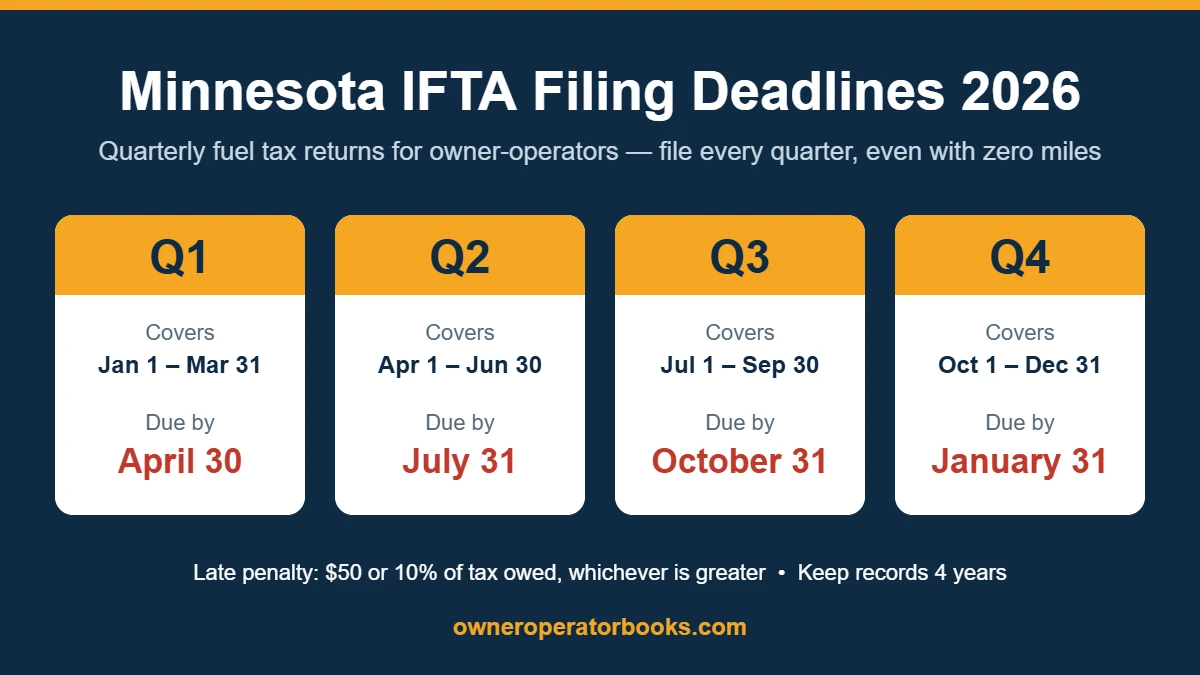
If a deadline lands on a weekend or legal holiday, it moves to the next business day. Two rules Minnesota drivers get burned by:
- You must file even with zero miles. Took a quarter off? Truck in the shop? Minnesota still requires a “zero return.” Skipping it counts as a late filing.
- The late penalty is $50 or 10% of the tax owed, whichever is greater. File one day late on a quarter where you owe nothing extra, and you’re still out $50. Interest also accrues monthly on unpaid tax. Late filings are pure waste; that money buys you nothing.
How IFTA Filing Minnesota Works Through DVS
Minnesota’s IFTA program is run by Driver and Vehicle Services (DVS) under the Department of Public Safety, right here in Saint Paul at 445 Minnesota Street.
Getting Licensed
- Apply through DVS using the IFTA License and Decals Application. Costs are modest: an annual filing fee of $12, an annual license fee of $28, and $2.50 per set of decals (one set per truck).
- You get one IFTA license and two decals per vehicle. Decals go on the exterior of both sides of the cab, and a copy of the license must be carried in every truck.
- Roadside, you can show the license as a paper copy or on your phone. If you’re missing decals or the license, you’re looking at trip permits, citations, or fines.
Renewal
- Your license is valid for the calendar year and expires December 31.
- Renewal opens in mid-October. Renew early, because processing takes time and you must be current on all quarterly returns to renew.
- There’s a grace period: new-year decals must be displayed by the end of February. Don’t count on it. Renew in the fall and forget about it.
What Records You Actually Need to Keep
IFTA runs on two data streams. Get these right and your IFTA filing Minnesota return practically writes itself. Get them wrong and you’re reconstructing a quarter from memory.
1. Miles by State
For every trip, record the date, route, odometer readings, and miles in each jurisdiction. If you run an ELD, much of this is already captured. Still, check that your ELD’s state-mileage report is accurate and that you’re actually saving it. ELD data is only useful if it’s retained and matches your fuel records.
2. Fuel by State
Every fuel purchase needs a receipt showing the date, seller name and location, fuel type, gallons, and price. Fuel card statements (Comdata, EFS, RTS, etc.) cover most of this automatically. Cash purchases without receipts are gallons you can’t claim, which raises your calculated MPG and can increase what you owe.
Keep everything for four years. That’s the standard IFTA audit window, and audits routinely reach back years. A shoebox doesn’t survive four years; a digital system does.
How the IFTA Math Nets Out: A Simple Example
Numbers make IFTA click. Say you run 30,000 miles in a quarter and buy 5,000 gallons of diesel. Your fleet MPG is 30,000 ÷ 5,000 = 6.0 MPG.
Now say 12,000 of those miles were in Minnesota and 18,000 were in Wisconsin, and you bought all 5,000 gallons in Minnesota. Using round tax rates for illustration only (Minnesota at $0.30 per gallon, Wisconsin at $0.33):
- Minnesota: 12,000 miles ÷ 6.0 MPG = 2,000 gallons burned, so $600 in tax owed. You already paid $1,500 at Minnesota pumps (5,000 × $0.30), so Minnesota owes you a $900 credit.
- Wisconsin: 18,000 miles ÷ 6.0 MPG = 3,000 gallons burned, so $990 owed. You paid nothing at Wisconsin pumps, so you owe the full $990.
- Net: $990 owed minus the $900 credit = $90 due on one return.
Real rates change every quarter and are published by IFTA, but the logic never changes. Notice how everything depends on accurate miles and accurate gallons. If receipts go missing, your MPG rises on paper, your credits shrink, and your bill grows. That’s why record-keeping is the heart of IFTA for owner operators.
How to File Your Minnesota IFTA Return, Step by Step
Once your records are in order, the IFTA filing Minnesota drivers do each quarter follows the same routine:
- Close out the quarter. On the last day of March, June, September, and December, export your ELD state-mileage report and your fuel card statements for the full quarter.
- Reconcile miles. Compare ELD miles to odometer readings and trip records. Fix gaps before you file, not after an auditor finds them.
- Reconcile gallons. Match every fuel card line and cash receipt to a date and location. Pull reefer fuel out of the total.
- Check your MPG. Divide total miles by total gallons. If the number looks off compared to last quarter, find out why before you submit.
- Complete the return. Enter miles and gallons by jurisdiction. The return applies each state’s current rate and nets it all into one balance due or credit.
- File and pay with DVS before the deadline. Save a copy of the filed return with that quarter’s records.
If you block out time for these steps the first week after each quarter ends, you’ll never scramble against IFTA deadlines again. Better yet, if your books are already reconciled monthly, steps one through four are done before the quarter even closes.
Why Clean Books Make IFTA Filing Minnesota Simple
Most IFTA problems aren’t tax problems. They’re bookkeeping problems that show up at tax time. When fuel purchases are categorized every month and settlements are matched to loads, the IFTA filing Minnesota requires each quarter becomes a quick report instead of a weekend project.
Clean books also protect you beyond IFTA. The same fuel and mileage records support your income tax deductions, your cost-per-mile, and any loan or lease application that asks for a profit and loss statement. One well-kept system does triple duty for IFTA for owner operators, taxes, and business decisions.
6 IFTA Filing Minnesota Mistakes That Cost Drivers Money
1. Filing Late, Including Zero Quarters
The $50-minimum penalty is the most avoidable expense in trucking. Put all four IFTA deadlines in your phone right now with a one-week-early alarm.
2. Estimated or “Gap” Miles
When reported miles don’t line up (odometer gaps, routes that don’t match fuel stops), auditors notice. Fabricated round numbers like “2,000 miles in Wisconsin” are an audit magnet. Real records, even imperfect ones, beat tidy guesses.
3. Losing Fuel Receipts
Every undocumented purchase inflates your MPG on paper. An artificially high MPG means the calculation thinks you burned less fuel than you paid tax on, and quarters stop netting in your favor. Photograph every receipt the moment it’s in your hand.
4. Mixing In Reefer Fuel
Fuel pumped into your reefer unit is not propulsion fuel and doesn’t belong in your IFTA gallons. Mixing it in distorts your MPG. Pump reefer fuel on a separate transaction and note it. That fuel may also qualify for separate tax refunds, which is money most drivers never claim.
5. Ignoring MPG Sanity Checks
Your fleet MPG should land in a believable range (most trucks run roughly 5–8 MPG) and stay consistent quarter to quarter. A sudden jump from 6.2 to 9.1 doesn’t mean your truck got efficient. It means records are missing, and auditors screen for exactly this.
6. Treating IFTA and Bookkeeping as Two Separate Chores
This one wastes the most time. Your fuel purchases are already a bookkeeping entry (they’re your biggest deductible expense), and your miles are already the basis of your cost-per-mile. Drivers who track IFTA separately from their books do the same work twice, or worse, keep two versions of the truth that don’t match. Whether you use a bookkeeper or QuickBooks for owner operators, one system should feed both.
What an IFTA Audit Looks Like (and How Not to Fear One)
Base jurisdictions audit a small percentage of licensees every year, so over a trucking career, an audit isn’t unlikely; it’s eventual. Auditors compare your reported miles against ELD/GPS data, match fuel claimed against receipts, and check that your MPG holds together.
Drivers with clean, consistent, retained records experience an audit as paperwork. Drivers with gaps experience it as assessments, penalties, and interest. When records are missing, auditors are allowed to estimate against you, including reducing your claimed MPG, which raises your bill.
The defense isn’t clever. It’s boring: complete records, kept continuously, stored digitally, for four years.
If you do receive an audit notice, don’t panic and don’t guess. Gather your ELD reports, trip records, fuel card statements, and receipts for the quarters listed, and respond by the date on the letter. If records are incomplete, bring in a professional before the audit meeting, not after. A bookkeeper who knows trucking can often rebuild missing miles or gallons from settlements, fuel card data, and load records, which keeps estimated assessments to a minimum.
The Easiest Version of IFTA: Have Someone Else Do It
Everything above is doable yourself, and plenty of drivers manage it. But be honest about the math: hours each quarter gathering records, calculating jurisdictions, filing with DVS, and carrying the “did I do that right?” feeling every single quarter, forever.
At Owner Operator Books, IFTA isn’t an add-on. It’s built into how we keep your books. Because we’re already reconciling your fuel cards and settlements every month, your miles and gallons are tracked by state continuously. When a deadline approaches, your quarterly return is prepared from records that are already clean: filed on time, every time, audit-ready by default.
We’re based in Saint Paul, the same city as the DVS office that runs the program, and we handle IFTA filing Minnesota owner-operators rely on every quarter, along with drivers based across the country.
IFTA Filing Minnesota FAQs
When is IFTA filing Minnesota due in 2026?
Minnesota IFTA returns are due quarterly: April 30 (Q1), July 31 (Q2), October 31 (Q3), and January 31 (Q4). If a deadline falls on a weekend or legal holiday, it moves to the next business day.
Do I have to file an IFTA return if I didn’t drive?
Yes. Minnesota requires a zero return for any quarter with no miles. Skipping it counts as a late filing and triggers the minimum penalty.
What is the penalty for filing IFTA late in Minnesota?
The late penalty is $50 or 10% of the tax owed, whichever is greater, plus monthly interest on any unpaid tax.
How much does a Minnesota IFTA license cost?
Through DVS, you pay a $12 annual filing fee, a $28 annual license fee, and $2.50 per set of decals (one set per truck).
How long should owner-operators keep IFTA records?
Keep mileage and fuel records for at least four years. That is the standard IFTA audit window.
Do leased owner-operators need their own IFTA license?
Usually not. If your carrier reports fuel tax under its own IFTA license, you don’t file. Once you run under your own authority, IFTA filing becomes your responsibility.
Book a free consultation. It takes 15 minutes, and you’ll know exactly what it takes to never worry about IFTA deadlines again. If you’re behind on past quarters, we handle catch-up filings and bookkeeping too. No judgment, just fixed.
Disclaimer: This article is general information, not tax or legal advice. IFTA fees, forms, and procedures can change. Verify current requirements with Minnesota DVS or a qualified professional for your specific situation.