

The day you hire your first W-2 driver, your trucking business picks up a new set of tax bills. Two of the most confusing are SUTA and FUTA. They show up on every payroll report, they’re paid on different schedules, and getting them wrong can mean penalties from both the IRS and the state.
So, what is SUTA tax, and does your trucking business have to pay it? This simple guide explains what SUTA is, how it works with FUTA, and what owner-operators and small fleet owners in Minnesota need to know for 2026.
Key takeaways:
- SUTA is a state unemployment tax that only employers pay — it’s never taken out of a Minnesota driver’s paycheck.
- In 2026, Minnesota SUTA applies to the first $44,000 of each employee’s wages.
- FUTA is the federal version: 0.6% on the first $7,000 if you pay your state tax on time.
- Solo owner-operators with no employees generally don’t pay SUTA on their own earnings.
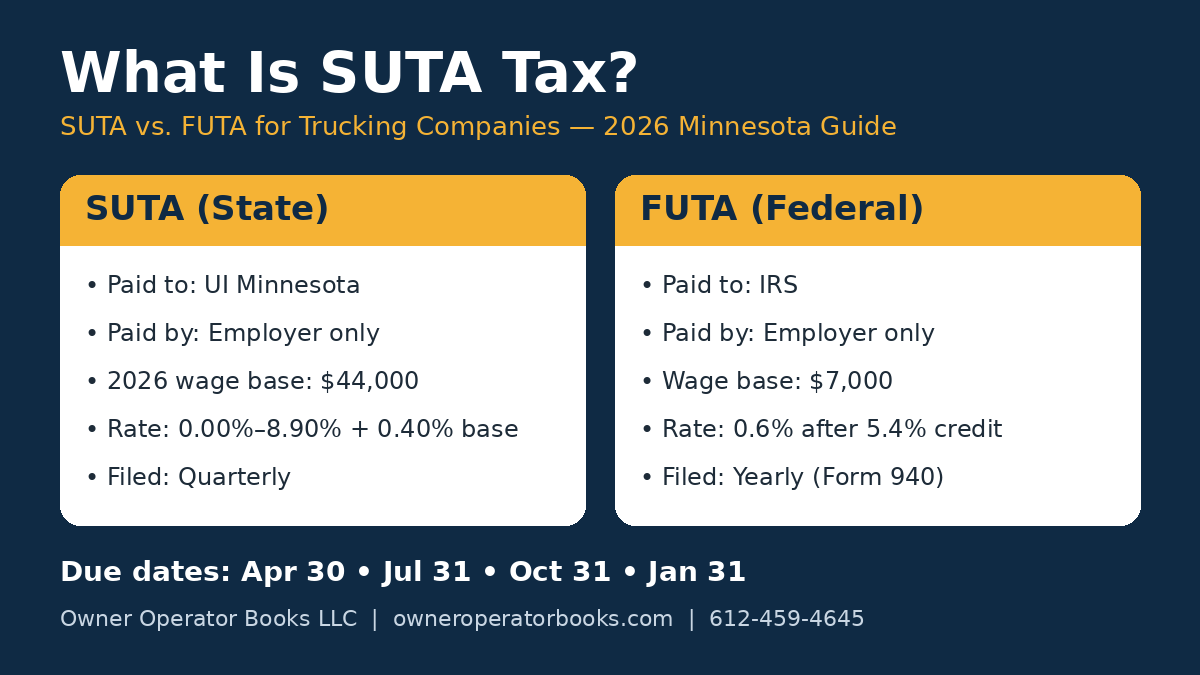
What Is SUTA?
SUTA stands for the State Unemployment Tax Act. If you’re asking “what is SUTA,” the short answer is this: it’s a payroll tax employers pay to their state to fund unemployment benefits for workers who lose their jobs through no fault of their own.
Key points:
- Employers pay it, not employees. In Minnesota and most states, you can’t withhold SUTA from a driver’s paycheck.
- It’s only charged on wages up to a cap, called the taxable wage base.
- Your rate depends on your history. Businesses with more former employees collecting unemployment pay higher rates.
You may also see SUTA called SUI (State Unemployment Insurance) or simply “state unemployment tax.” In Minnesota, it’s managed by Unemployment Insurance Minnesota (UI Minnesota).
What Is FUTA?
FUTA stands for the Federal Unemployment Tax Act. It’s the federal side of the same system. FUTA money pays for running state unemployment programs and covers loans to states whose funds run low.
- The FUTA rate is 6.0% on the first $7,000 of each employee’s wages per year.
- If you pay your state unemployment tax in full and on time, you get a credit of up to 5.4%, which brings your real FUTA rate down to 0.6%.
- That works out to a maximum of $42 per employee per year for most employers.
- You report FUTA on IRS Form 940 once a year.
What Is SUTA vs. FUTA? The Key Differences
| SUTA | FUTA | |
|---|---|---|
| Who collects it | Your state (UI Minnesota) | The IRS |
| Who pays it | Employer | Employer |
| 2026 wage base | $44,000 in Minnesota | $7,000 (everywhere) |
| Rate | Varies by employer | 0.6% after the full credit |
| How often you file | Quarterly | Yearly (Form 940), with deposits as needed |
Think of them as a team: paying SUTA on time is what earns you the big discount on FUTA. Pay your state late and you can lose part of that credit. Don’t pay it at all and your FUTA bill can jump from $42 to as much as $420 per employee.
Do Owner-Operators Have to Pay SUTA?
This is where trucking gets tricky. It depends on how your business is set up and who works for you.
1. Solo owner-operator, no employees
If you’re a sole proprietor or single-member LLC driving your own truck, you generally do not pay SUTA or FUTA on your own earnings. You pay self-employment tax instead. (If your LLC elected S-corp status and pays you a W-2 salary, that changes things — talk to your bookkeeper.)
2. Leased onto a carrier as an independent contractor
The carrier usually doesn’t pay SUTA on you as long as you’re properly classified as an independent contractor. Minnesota looks closely at how much control the carrier has over your work. If you’re treated like an employee, the state may decide you are one.
3. Small fleet owner with W-2 drivers or office staff
Yes, you pay SUTA and FUTA. Once you hire employees — drivers, a dispatcher, or office help — you need to register with UI Minnesota and start filing quarterly wage reports. Not sure what a new driver really costs you? See our guide to your true cost per mile.
4. Family members
If your business is a sole proprietorship, federal rules exempt from FUTA the wages you pay your spouse, your child under 21, or your parent. These exemptions do not apply if your business is a corporation (including an S-corp). State rules can differ, so confirm before you leave family members off your Minnesota wage reports.
What Is SUTA Tax in Minnesota? 2026 Rates
Here’s what Minnesota trucking employers need to know for 2026:
- Taxable wage base: $44,000 per employee
- Base tax rate: 0.40% (added to your experience rate)
- Experience rates: range from 0.00% to 8.90%
- New employers: get a rate assigned based on their industry, plus the 0.40% base tax
- Additional assessment: 14% for 2026 (a surcharge figured on your experience rate, not a separate tax on wages)
- Special assessment: none for 2026
Minnesota mails each employer its assigned rate every December for the year ahead. Always use the rate on your rate notice — not a general number from the internet.
Good news for Minnesota employers: Minnesota is not on the projected 2026 FUTA credit reduction list, so you should keep the full 5.4% credit if you pay your state tax on time. (Employers in California may face a reduction for 2026.)
Example: A Small Minnesota Fleet
Say you run three trucks with three W-2 drivers, each earning $60,000 a year, and your total Minnesota rate is 2.0%. (This rate is just for illustration.)
- SUTA: $44,000 × 2.0% = $880 per driver → $2,640 a year
- FUTA: $7,000 × 0.6% = $42 per driver → $126 a year
- Total unemployment tax: $2,766 a year
Once a driver’s pay passes $44,000, you stop paying Minnesota SUTA on that driver for the rest of the year. That’s why your payroll costs usually drop later in the year.
When Are Minnesota SUTA Taxes Due?
Minnesota employers file a wage detail report and pay the tax every quarter:
| Quarter | Due Date |
|---|---|
| Q1 (Jan–Mar) | April 30 |
| Q2 (Apr–Jun) | July 31 |
| Q3 (Jul–Sep) | October 31 |
| Q4 (Oct–Dec) | January 31 |
Payments must be received by the due date. If a date falls on a weekend or holiday, it moves to the next business day. You still have to file a Zero Wage Report for any quarter with no wages. Late reports and late payments bring penalties and interest — and can cost you part of your FUTA credit.
New in 2026: Minnesota Paid Leave. Starting January 1, 2026, Minnesota employers also pay Paid Leave premiums (0.88% of wages, or 0.66% for employers with 30 or fewer employees). The cost can be split with employees, and premiums are paid on the same quarterly schedule as unemployment insurance. If you run payroll for drivers, budget for both.
Common SUTA Mistakes Trucking Companies Make
- Calling drivers 1099 contractors when they’re really employees. This is the most expensive mistake in trucking. If the state reclassifies your drivers, you can owe back SUTA, penalties, and interest for years.
- Not registering after the first hire. Many small fleets run payroll for months before registering with UI Minnesota. If you’re already behind, our catch-up bookkeeping guide shows how to fix it.
- Using last year’s rate. Your rate can change every year. Update it in your payroll software every January.
- Paying SUTA after the wage base is reached. Overpaying on drivers who have already passed $44,000 is wasted money.
- Filing in the wrong state. Drivers who cross state lines create confusion. SUTA usually goes to the state where the driver is based or where their work is directed from — not every state they drive through.
- Missing zero-wage reports. Even quarters with no payroll need a report.
Payroll tax isn’t the only deadline truckers juggle. Make sure you’re also on top of IFTA filing in Minnesota and claiming every truck driver tax deduction you’re owed — SUTA and FUTA are deductible business expenses too.
How Owner Operator Books Can Help
At Owner Operator Books LLC, we’ve spent 15 years doing bookkeeping for truck drivers and owner-operators. When you grow from one truck to a small fleet, our trucking bookkeeping services help you:
- Set up payroll and register with UI Minnesota the right way
- Review driver classification (W-2 vs. 1099) before it becomes a problem
- Track wage bases so you never overpay SUTA
- Keep your books, IFTA records, and payroll taxes clean and tax-ready
We serve owner-operators and fleet owners across Saint Paul, Minneapolis, and the Twin Cities metro.
Hiring your first driver? Book a free 15-minute consultation or call 612-459-4645.
Frequently Asked Questions About SUTA
What is SUTA in simple words?
SUTA is a state tax that employers pay on employee wages to fund unemployment benefits. It is paid quarterly and only on wages up to the state’s wage base — $44,000 per employee in Minnesota for 2026.
What is SUTA tax going to cost a Minnesota trucking company in 2026?
It depends on your business. Minnesota experience rates range from 0.00% to 8.90%, plus a 0.40% base tax, on the first $44,000 of each employee’s 2026 wages. New employers receive a rate based on their industry.
What is SUTA vs. FUTA?
FUTA is the federal unemployment tax paid to the IRS (0.6% on the first $7,000 after the state credit). SUTA is the state unemployment tax paid to your state, with a rate and wage base set by the state.
Do I pay SUTA as a self-employed truck driver?
Generally no. Sole proprietors and single-member LLC owners don’t pay SUTA on their own earnings. You do pay it once you have W-2 employees, such as drivers or office staff.
Can SUTA be taken out of an employee’s paycheck?
Not in Minnesota. SUTA is an employer-paid tax. A few states, like Alaska, New Jersey, and Pennsylvania, also take a small amount from employees.
Is SUTA tax deductible?
Yes. SUTA and FUTA are ordinary business expenses and are deductible on your business tax return.
This article is for general information and isn’t tax or legal advice. Rates and rules can change — check your UI Minnesota rate notice or talk with a bookkeeping professional about your situation.