

30+ write-offs owner-operators often miss, plus the 2026 per diem rate, Section 179 limit and IFTA deadlines. One PDF, four pages, free.
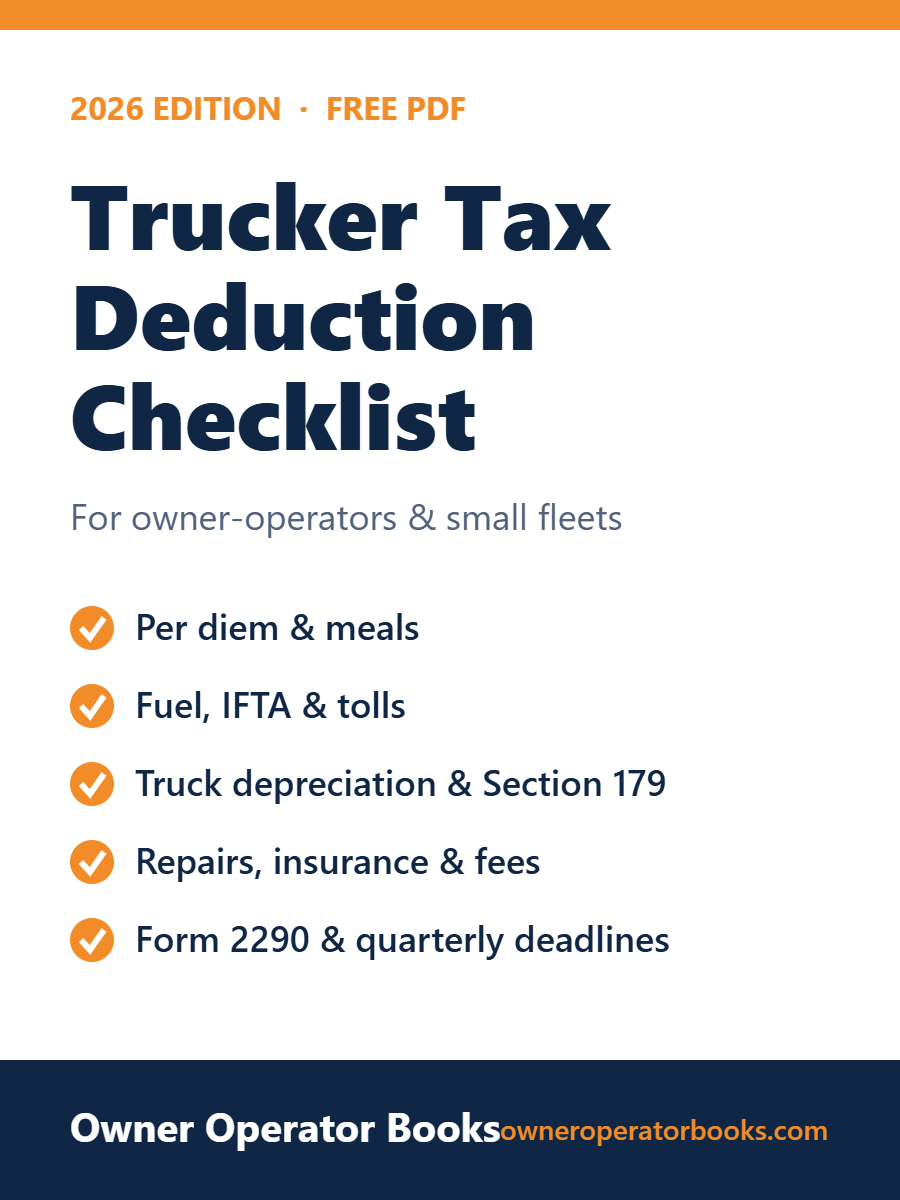
Instant download. Four pages, print-ready, no sign-up needed.
Download the Free PDFWant help applying it to your books? Book a free 15-minute call or call (612) 459-4645.
Owner-operators, lease-on drivers and small fleets with 1–10 trucks. If you get settlements, pay for your own fuel and file IFTA, this trucker tax deduction checklist was written for you.
The trucker tax deduction checklist is four pages, organized the way your expenses actually happen on the road. Print it, keep it in the cab, and tick off each item as you collect receipts. Here is what each section covers.
Depreciation on your tractor and trailer, loan interest, lease payments, and the difference between Section 179 and bonus depreciation. It explains why your monthly truck payment is not a deduction by itself and what you claim instead.
Diesel, DEF, reefer fuel, scale tickets, tolls and parking. It shows how to match fuel receipts to your IFTA miles so your tax return and your quarterly IFTA filing tell the same story.
The 2026 special transportation rate of $80 per day inside the U.S., the 80% limit for drivers under DOT hours-of-service rules, and the partial-day rule for the days you leave and return home.
Tires, oil changes, preventive maintenance, breakdowns, truck washes and shop supplies. It also flags which big repairs may need to be capitalized instead of written off in one year.
Form 2290 heavy vehicle use tax, IRP plates, UCR, permits, DOT physicals, drug testing, liability, bobtail and cargo insurance, ELD subscriptions and load board fees.
Cell phone and data plans, bookkeeping and tax prep fees, work boots and safety gear, cab supplies, and the home office deduction if you run dispatch from home.
Tax figures change every year, so the trucker tax deduction checklist puts the ones owner-operators ask about most on a single page. A few highlights:
For the official rules, see IRS Publication 463 on travel expenses and the IRS Form 2290 page. Minnesota drivers should also read our truck driver tax deductions in Minnesota guide, because Minnesota does not follow federal bonus depreciation.
If you are an owner-operator away from your tax home overnight, you can deduct a standard daily amount for meals and incidentals instead of saving every food receipt. For the IRS year that started October 1, 2025, the special transportation industry rate is $80 per full day in the continental U.S. Because you are subject to DOT hours-of-service rules, you can deduct 80% of that amount instead of the usual 50%. That works out to $64 per full day. Over 250 days on the road, that is $16,000 in deductions from per diem alone, which is why it sits at the top of the trucker tax deduction checklist.
When you buy a truck or trailer, you do not have to deduct the full price the year you pay for it. Regular depreciation spreads the cost over several years. Section 179 lets you expense qualifying equipment in the year you place it in service, up to the annual limit and not more than your business income. Bonus depreciation, restored to 100% for property acquired after January 19, 2025, also lets you write off the full cost in year one and can even create a loss. Taking everything at once is not always the best move. A big deduction in a slow year may be partly wasted, and you give up write-offs in later years when your income may be higher. The trucker tax deduction checklist lists the questions to ask your tax preparer before you decide.
Fuel is usually your biggest expense, and it is also the one that has to agree with another filing. The gallons and miles on your IFTA return should line up with the fuel you deduct on your tax return. Keep every fuel receipt, including cash purchases, and reconcile fuel card statements every month. Gaps between the two are an easy flag for an auditor.
Owner-operators do not have taxes withheld from settlements, so the IRS expects payments four times a year. Missing them can trigger underpayment penalties even if you pay the full amount in April. A common rule of thumb is to set aside 25% to 30% of net profit, but your real number depends on your deductions. That is another reason to keep the trucker tax deduction checklist current all year instead of filling it out once in March.
Minnesota does not follow federal bonus depreciation. Minnesota filers who take bonus depreciation on their federal return generally add back 80% of it on the state return, then subtract it in equal parts over the following five years. If you run your truck out of Minnesota, plan for a higher state tax bill in the year you buy equipment. The checklist includes a reminder so this does not catch you by surprise at filing time.
Missing receipts is the most common problem we see. If your records are months behind, start with our guide to catching up on your trucking books. If you use QuickBooks, our post on QuickBooks for owner-operators shows how to set up categories that match this list. And if IFTA is the part you dread, read our IFTA filing Minnesota guide. Rather hand it all off? See our bookkeeping services for owner-operators.
Every spring we review books for new clients, and the same expenses show up missing again and again. None of them are unusual. They happen in small amounts, often in cash, and get forgotten by tax season. These are the ones a trucker tax deduction checklist helps you catch.
Catch even half of these and the savings often cover the cost of good bookkeeping several times over. The trucker tax deduction checklist lists each one with a box to tick, so nothing slips through.
A deduction only helps if you can prove it. The IRS expects receipts, logs or bank records for every expense you claim. Take a photo of each receipt the day you get it, keep your logs and settlement statements for at least three years, and run all trucking costs through one business bank account and one business card. Mixing personal and business spending is the fastest way to lose deductions in an audit. At the end of each month, compare your receipts against the trucker tax deduction checklist and your bank statement, and fix gaps while you still remember what each charge was for.
Yes. Enter your name and email and the PDF comes to your inbox right away.
No. It is a checklist of common deductions and 2026 figures. Your situation decides what you can claim, so review it with your tax professional.
Yes. Everything except the Minnesota note is federal and applies in every state.
Owner-operators, lease-on drivers and small fleet owners who file a Schedule C or run an LLC or S corp. Company drivers paid on a W-2 generally cannot deduct these expenses on their federal return.
Every year, once the IRS releases new per diem rates and depreciation limits. Subscribers get the new version by email.
Not directly. The principal part of a loan payment is not a deduction. Instead you deduct the interest on the loan and depreciate the truck itself, either over several years or all at once using Section 179 or bonus depreciation. Lease payments work differently, and the checklist explains both.
You need a record of the dates you were away from home overnight and where you were. Your ELD logs usually cover this, as long as you keep them. You do not need meal receipts when you use the standard per diem rate, but you do need proof of the days.
Yes. Book a free consultation and we’ll go through your 2026 expenses together.
Get the free 2026 trucker tax deduction checklist and see what you’ve been missing.
Send Me the Free Checklist